

Power & Energy Magazine
Home / Power & Energy Magazine
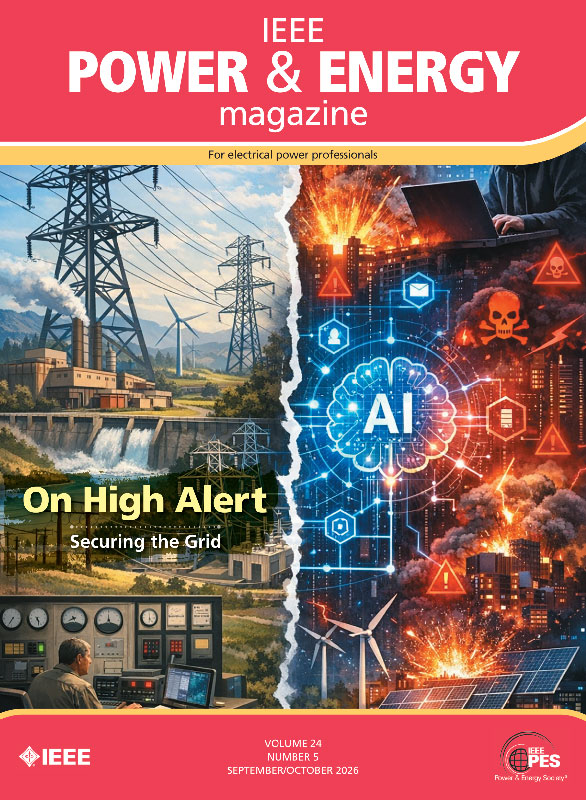
On High Alert: Securing the Grid
Published: September/October 2026
Volume 24, Number 5
In this issue:
- Building A Cyber-Resilient Smart Grid With Artificial Intelligence-Driven Defense
- Cybersecurity of Control Room of the Future
- AI-Enabled Security Operations Center (SOC) for Modern Power Grids
- Improving Network-Based Security and Resilience of the Power Grid
- Guarding Digital Substations
- Beyond the Checklist
- When the Grid Fights Back
About the Magazine
Impact Factor: 2.9
Launched in 2003, the IEEE Power & Energy Society (PES) has published IEEE Power & Energy Magazine, a bimonthly magazine dedicated to disseminating information on all matters of interest to electric power engineers and other professionals involved in the electric power industry. Feature articles focus on advanced concepts, technologies, and practices associated with all aspects of electric power from a technical perspective in synergy with nontechnical areas such as business, environmental, and social concerns. IEEE Power & Energy Magazine keeps its readers up-to-date on the latest technological advancements, industry news, business trends and strategies, products, and publications. Important newsworthy items concerning the worldwide activities and achievements of PES, its organizational units, and its individual members are included. The publication is available in a printed copy and on the web.
Digital Edition Subscription Rates:
Non-Member rate: US $75.00
IEEE Professional Member rate: US $35.00
IEEE Student Member rate: US $18.00
Sponsoring society member rate: included with membership
Sponsoring society student member rate: included with membership
Advertise in Power & Energy Magazine:
For ad sales opportunities, please download the media kit here.
Submission Information:
Each issue of IEEE Power & Energy Magazine includes several articles that contribute to a theme. The great majority of articles are invited papers managed by guest editors. On occasion, the opportunity arises to include an unsolicited submission.
For consideration for publication in IEEE Power & Energy Magazine, articles should be submitted as Word files in single-column format. All text components of the article should be included, with all graphics, tables, and sidebar material shown in their desired location within the body of the article. Articles are limited to 6 magazine pages, corresponding to approximately 5,000 words, including graphics. Submissions should be submitted via the P&E Magazine Author Portal.
Guidelines for authors can be downloaded HERE and a template for articles can be downloaded HERE.
Following approval, authors will submit their final files via the Manuscript Central paper submission site. Instructions will be in the acceptance email. Text files must include all text components of the article (e.g., body of the article, figure captions, tables, sidebars, if any, and brief author biographies), and should be submitted in Microsoft Word. Separate graphics files (300 dpi minimum) should be submitted in encapsulated postscript (.eps), TIFF (.tif), or JPG format; name each file according to its relationship to the article, e.g., fig1.eps, fig2.tif, etc.
Prior to publication, you will receive a review copy of your edited text for final approval and be required to sign an online IEEE Copyright Form.
Please note that a magazine article differs considerably from a technical paper which is prepared for Transactions status. Magazine articles do not contain abstracts, keywords, conclusions, and references (though suggested “further readings” are acceptable). Magazine articles do not employ equations or formulas; “if it cannot be said in words, it does not belong in a magazine article.” Also, as Power & Energy Magazine is a four-color publication, articles should be accompanied with informative graphics, photos, and screen captures to enhance their content and be attractive to readers.
Upcoming Issue Themes:
Note the production themes change sometimes, that’s why the themes are not tied to a specific issue.
2026 P&E Magazine Issue Themes:
January February 2026
Stability analysis and control of power electronics dominated systems
March April 2026
Flexibility for Resilience – experiences and lessons learned through collaboration
2026 T&D Special Issue
May June 2026
AC/DC Hybrid Distribution Network and Protection
July August 2026
Integrated Grid Planning
September October 2026
Cybersecurity for Smart Grid in the AI Age
November December 2026
Planning and Operation of Power System with Large Loads